

Can I Warm Up With Just Songs, or Do I Need to Vocalize?

The quick answer: Yes, you can warm up with songs. Just not only songs. Vocalize first so you know what your voice has to work with today, then use your songs to fine-tune. Here's how, plus a 10-minute warm-up for the drive.
Okay, let's talk about this one, because I get asked all the time. "Monica, can I just warm up by singing through my set? Do I really have to do all the lip rolls and scales?"
I get it. Scales can feel like homework, and nobody ever bought a ticket to hear your lip trills. But here's the thing.
Your voice is different every day
Your voice carries a lot. What you ate, how much sleep you got, how stressed you are, whether you're coming down with something. All of that shows up in your voice.
Even experienced singers have days when the voice isn't where they want it. Warm-up time is your chance to figure out where your voice is weak today, and which coordinations it can actually get to right now.
Why warming up with just songs isn't enough
Think about the gym (stay with me, even if your membership is mostly a monthly donation). You've got your strong muscles that are already there, and your weak ones that need work. A good workout creates balance through your whole body. Your voice works the same way.
When you only sing songs, you're stretching your voice, but you haven't given those coordinations a chance to show up. The weak spot hasn't been conditioned to connect yet. So when you hit that spot in the song, one of two things happens. You push too hard to get there, or you try to muscle that coordination together.
That's when you strain from the first song, or tire out way faster than you should. You can even hurt yourself, because you haven't warmed up in a way that sets you up for a mixed, balanced sound.
What a real warm-up does (and what I'm listening for)
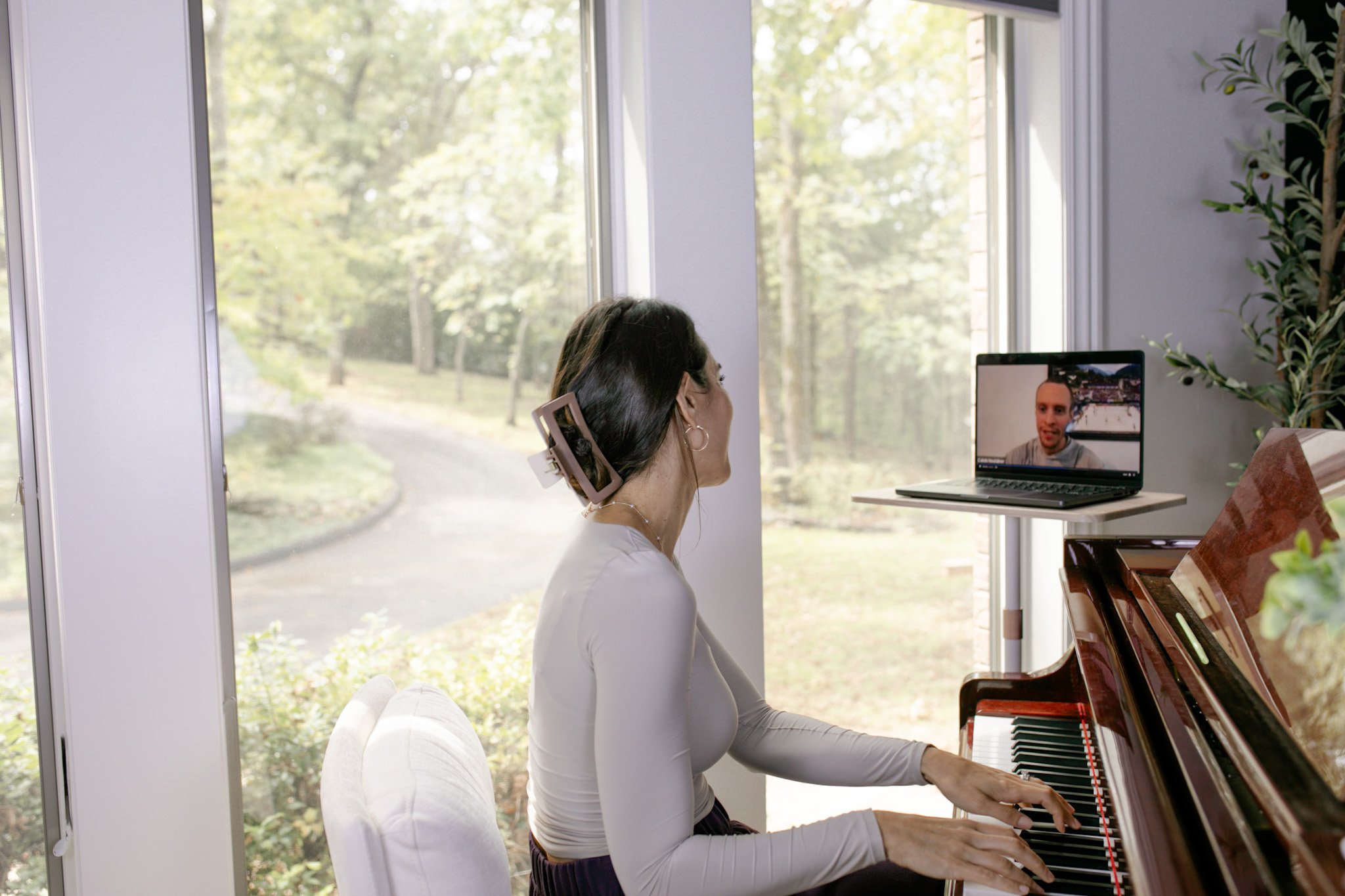
When I warm up a student in a one-on-one lesson, I'm listening as much as we're singing. Here's my order.
1. Start with SOVT. That's short for semi-occluded vocal tract. Fancy name, simple idea: your mouth is partly closed off, like singing through a straw into water, doing lip rolls, or singing on a muffled "oh." That creates gentle back pressure that eases your voice into working. Voice scientist Ingo Titze explains that these exercises lower the pressure it takes to get your voice going, cut down on how hard your vocal folds hit each other, and support mixed registration. So yes, blowing bubbles in your water is science.
I'll do this on a five-tone or Rossini scale for three to five minutes. I'm listening for inflammation, or any part of the range that doesn't want to connect, where the cords don't want to close up very well.
2. Check your head voice. Once that connects, I go up top. Is there tightness? Reaching? Or does it have the full release it needs?
3. Check your chest voice. For most people, chest voice is pretty much always there. Not always, though. If you were classically trained, especially as a woman, you might naturally have a more heady tone. In that case we don't need to spend much time on head voice, because you use it all the time. We'll work on your chest voice instead: that bottom, the depth in your sound.
4. Find your cry. Last, I listen for that whiny, twangy "cry" sound. It helps thin out your voice through the bridges and takes the weight off as you head up into higher notes.
How to use songs the right way
Once you've vocalized, songs are great for budiling coordinations in the voice. Just use them on purpose.
Your voice builds muscle memory. If you sing the same scale every single day, your voice learns it. Switching it up with different melodic patterns keeps tricking your voice and keeps it flexible. Here's how:
Pick out the line that gives you trouble. You know the one.
Sing it on "mum." An easy vowel and consonant combo lets you work out the coordination without the lyrics getting in the way.
Put the words back in. Now notice which vowels or consonants are tripping you up. Those are the ones to modify.
Your 10-minute warm-up for the drive

Let's be honest, sometimes those call times are rough, you've either stayed up late the night before or find yourself having to be ready for the 7 a.m. worship run-throughs. You boyd might be up, but your voice is still in bed, and croaky. So use your drive to the event to warm up. Here's what I'd try to start:
Straw and water (about 3 minutes). Fill up your water bottle, pop a straw in, and blow bubbles on a five-tone or Rossini scale from the bottom of your range to the top. Let the people at the red light wonder.
"Woo" for head voice. Do an octave arpeggio, top down or bottom up, whichever feels better for your voice.
"Gwee." This activates a little more vocal cord connection but keeps it relaxed.
"Ng" (a hum). Do it on a five-tone scale, or sirens from bottom to top, so your voice keeps thinning out once you've got some release.
"Nah." Now you're engaging consonants and opening up the sound.
"Mum." This brings everything to a balanced, speech-like quality.
"Buh" (optional). Your chest voice will pretty much be there by now, but if it wants a little extra punch, do "buh" on a five-tone scale.
And no, you don't need an hour. A University of Miami study published in the Journal of Voice found that 5 or 10 minutes seemed to be enough to start a practice session, and singers didn't feel longer routines helped more. Ten minutes in the car is plenty.
Off day, or something more?
Not every warm-up will feel smooth. Here's how to tell what's going on:
Normal off day: your voice glitches, breaks, or snaps back a little. Keep warming up. That's exactly what it's for.
Time to rest: your voice keeps feeling scratchy, or it hurts to swallow. Stop and give it a break.
Time to see a doctor: your voice hasn't improved after two weeks. Mayo Clinic gives the same two-week guideline for hoarseness that isn't getting better. See an ENT or laryngologist, who can do a videostroboscopy. That's an exam that films your vocal cords in slow motion while you sing or talk, so they can actually see what's going on and make sure there aren't any polyps or nodes.
The bottom line
Your songs aren't the enemy, even though they feel it sometimes. They're just not step one. Vocalize first so you know what your voice has to give today, then let your songs do the fine-tuning.
Want help building a warm-up that fits your voice? Book a free Vocal Discovery Lesson and we'll figure it out together.